What UV Index Is Best for Tanning Without Burning?
You can tan from a UV index of about 3 and up, and UV 3 to 5 has the lowest burn risk. But every sun tan is UV damage, and burn speed depends on your skin type.
Published
Key takeaways
- No UV index gives you a tan without damage. A tan is your skin repairing UV injury, so tanning without burning still means damaging your skin, just more slowly. The Skin Cancer Foundation says plainly there is no safe or healthy tan.
- The sun can tan (and burn) you from a UV index of about 3. Below 3 it is usually too weak to do either, and 3 is also the level where Cancer Research UK says to start protecting your skin.
- UV 3 to 5 is the lowest-burn-risk window. Burn speed rises fast with the number, so time that is mild at UV 3 can burn fair skin at UV 8 or higher.
- Your skin type sets the clock. At the same UV index, fair skin burns far sooner than deeper skin, so there is no single safe tanning time.
- Check the UV forecast, not the temperature. UV, not heat, decides burn risk, so a cool day can still read UV 7 or 8.
There is no UV index that gives you a tan without damage, because the tan is the damage. A tan is your skin’s response to UV injury, and the Skin Cancer Foundation is blunt about it: there is no such thing as a safe or healthy tan. If you are going to tan anyway, the lowest-burn-risk window is a UV index of about 3 to 5. You can tan from roughly UV 3 and up, since below that the sun is usually too weak to do much, but burn risk climbs fast as the number rises and depends heavily on your skin type.
Can you tan at UV 3?
Yes. A UV index of 3 is roughly the point where the sun becomes strong enough to change your skin, which is also why it is the level where sun-safety advice kicks in. Cancer Research UK marks UV 1 to 2 as low, with no sun protection needed, and UV 3 and above as the range where you should start protecting your skin. Below UV 3 the rays are usually too weak to tan or burn most people; at 3 and up they are strong enough to do both.
The catch is that “strong enough to tan” and “strong enough to damage your skin” describe the exact same threshold. There is no setting of the sun that tans you without also aging and injuring your skin. Our UV index scale guide breaks down what each band from 1 to 11+ means for your skin.
What UV index is best for tanning?
If the goal is the least burn risk while still getting some color, a moderate UV index of 3 to 5 is your window. The logic is simple: Cancer Research UK notes that the higher the UV index number, the less time it takes for your skin to become damaged. So at UV 3 to 5 you have more room before skin starts to burn than you do at UV 8, where fair skin can burn in under 15 minutes. Higher UV tans faster, but it burns faster too, and the burn is the part you cannot undo.
Two honest caveats. First, “best for tanning” is not the same as “safe”: every row in the table below is still UV damage. Second, the numbers assume you check the actual UV forecast rather than the temperature, because UV strength and how warm it feels are not the same thing.
| UV index | Can it tan you? | Burn risk |
|---|---|---|
| 0–2 (Low) | Barely; the sun is usually too weak | Very low for most skin |
| 3–5 (Moderate) | Yes, slowly | Lowest of the tanning range; fair skin still needs care |
| 6–7 (High) | Yes, faster | Meaningful; protection recommended |
| 8–10 (Very high) | Yes, quickly | High; fair skin can burn in under 15 minutes |
| 11+ (Extreme) | Yes, very quickly | Severe; skin can be damaged in minutes |
A base tan does not buy you extra room here either. It is worth only about SPF 3 or 4, according to MD Anderson, and it is itself damage, so it is not a shortcut to longer, safer time in the sun.
Why is every tan a sign of skin damage?
When UV hits your skin, it damages the DNA in your skin cells. Your body responds by sending melanin, the brown pigment, up toward the surface to shield the cells underneath. That pigment is the tan, which means the color only shows up after the damage is already done. MD Anderson puts it in three words: tanned skin is damaged skin.
There is a rough division of labor in the rays. Tanning is driven mostly by UVA, which penetrates deeper, while burning and vitamin D come more from UVB. Both harm your skin. The Skin Cancer Foundation describes the glow of a tan as evidence of DNA injury, and adds that tanning does not protect against sunburn; it simply exposes you to more UV.
Does your skin type change how fast you tan?
A lot. The same UV index affects two people very differently depending on their skin. Cancer Research UK notes that people with naturally darker skin tones burn less easily and have a lower risk of skin cancer, while fair skin that burns easily needs more care at every level. That is why there is no single answer to “how many minutes can I tan.”
How fast each skin type burns at each UV index is its own detailed question, and our UV index guide covers how quickly the higher bands burn. The short version: the fairer your skin, the sooner even a moderate UV index starts to cost you.
How to tan more safely, if you are going to
No dermatologist will tell you a suntan is safe, and the Skin Cancer Foundation is clear that there is no safe way to get one from the sun. But if you are going to be out in it, a few habits lower the odds of a burn:
- Aim for a moderate UV window (index 3 to 5) instead of peak midday, when the number is highest.
- Keep sessions short, and know roughly how fast your own skin burns.
- Still wear sunscreen. It slows burning without stopping a tan, and it is not a pass to stay out longer.
- Check the UV forecast, not the thermometer. A cool, breezy day can still read UV 7 or 8.
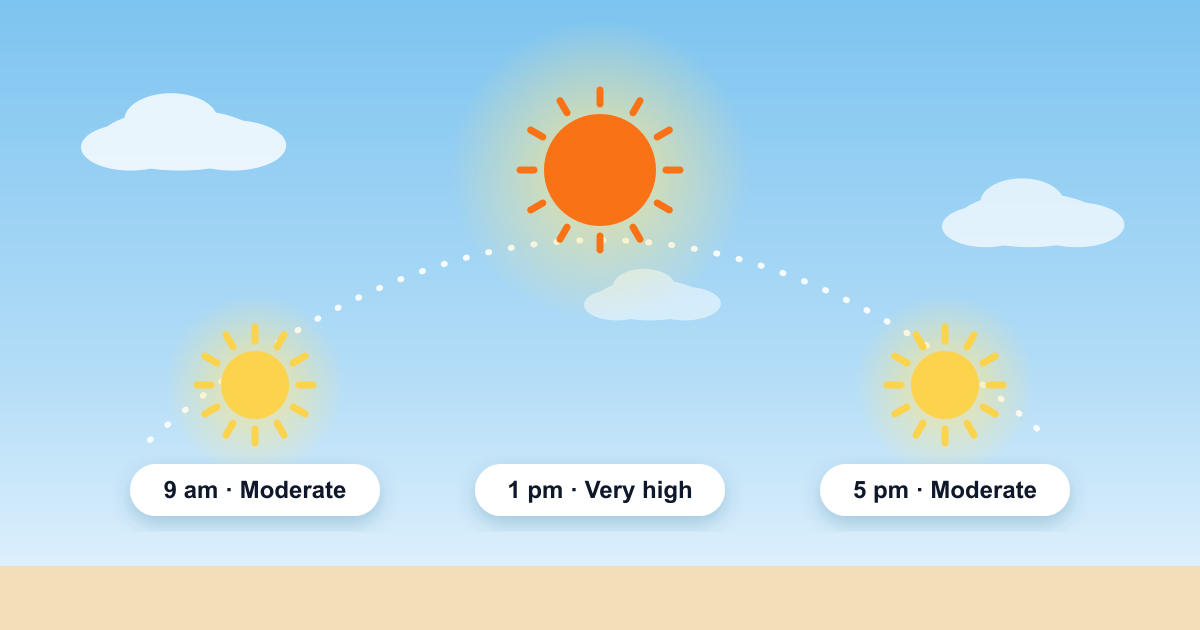
That last point is the one people get wrong most, and it is exactly what Skyvo is built for. It shows the UV index for your location hour by hour, so you can see when the number drops into that lower-risk 3-to-5 window, and it tailors burn-time estimates to your skin type, so “keep it short” becomes an actual number instead of a guess. Because it puts the air quality on the same screen, one glance tells you whether it is a good time to be outside at all.
So what UV index is best for tanning without burning? Honestly, the safest answer is none: the only tan that costs your skin nothing is a sunless one from a bottle. But if you are set on real sun, a UV index of 3 to 5, short sessions, and a forecast you actually check are how you keep a tan from turning into a burn. Knowing the number before you step outside is the whole game, and it is the habit Skyvo is designed to make automatic.
Frequently asked questions
What UV index can you tan at?
You can start to tan at a UV index of about 3, the level where the sun is strong enough to affect your skin. Below UV 3, Cancer Research UK says no sun protection is needed because the rays are too weak to do much. Remember that any tan, at any UV level, is still UV damage.
Can you get a tan without burning?
Yes, if you keep sessions short at a moderate UV index of 3 to 5 and you know how fast your skin burns. But tanning without burning is not the same as tanning without harm. A tan is your skin reacting to UV injury, so you are still building up damage, just more slowly.
Is a tan ever healthy or safe?
No. The Skin Cancer Foundation states there is no such thing as a safe or healthy tan, because the color is evidence of DNA injury to your skin. A tan from the sun or a tanning bed always means UV damage has already happened, whatever your skin tone.
What is the safest way to get a tan?
The only tan that does not damage your skin is a sunless one from a self-tanning lotion, spray, or mousse. Every tan from the sun or a tanning bed is UV damage, per the Skin Cancer Foundation, so if you want color without the risk, dermatologists point to sunless products instead.
Sources
Get Skyvo on your phone
Track the UV index and air quality wherever you are. Free on iPhone and Android.